force of nature: finding other ways to feel climate emotions
Posted on October 13, 2025

Force of Nature is an organisation that empower young people to get involved in climate action. They invited me to contribute to Climate Cafes, an international initiative where communities can host a climate cafe to share concerns and knowledge around the environment. I contributed the below immersive activity to the initiative:
Learning The Languages of Trees
It’s hard to listen to the environments around us – we might not know their languages. How to go about listening to a forest, as you do a friend? Could you understand the lands around you best through smell, touch, taste, skilled perception? Many have learnt the languages of the environments that surround them – from tracing the future presence of storms through the shape of the waves to understanding that a cow is in pain because their unborn calf is facing the wrong way. Through listening, they may know what’s wrong and how to help.
Many of us don’t grow up with the embodied skills that can aid understanding – no one passed them down to us. Or perhaps we feel that environmental knowledge is the preserve of qualified specialists, such as ecologists or climate scientists.
Honing our own senses can radically open up our relationship to the environment. We can listen, and care, in new ways. Find an area with multiple trees and explore the immersive invitations below to see for yourself.
Invitation: Read The Clocks Of The Forest
Look around at the trunks of trees and see if you can see any eye-shaped or circular marks on the trunks. Some of these eye shapes will have a black line arched over them, like an eyebrow. These bumpy shapes mark the spot where a branch used to be. Trees often remove their own branches in a process called ‘self-pruning’. The cells at the base of the branch slowly weaken until the branch eventually drops off.
If there are many of these ‘eyes’ in the forest, this might suggest that the trees are older – they have grown and killed many branches. The past shape of a tree is told through the marks and bumps on its trunk.

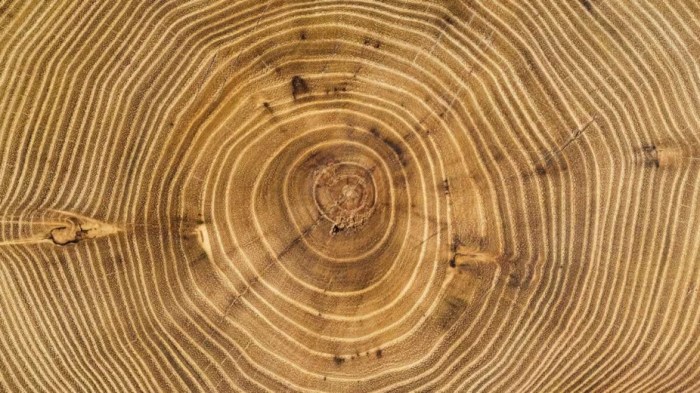
As you may know, we can read the age of trees through counting the rings on a trunk. Each lighter-toned ring represents a period of summer growth, while each darker-toned ring represents a period of winter growth. One year of growth is thus made up of one light + one dark ring. The summer rings are thicker, signalling the faster growth during sunnier, warmer months.
The rings also tell us about weather histories. Find a narrow ring, signalling low annual trunk growth, and that year may have been a drought. Many trees in Britain have a narrow ring from 1975-6, recalling a severe drought from that period.
Touch the bark of some of the trees around you. Are their trunks smooth or deeply ridged and fissured? Oak bark, along with many other trees, become more wrinkled when growing older – much like humans. Their cell divisions slows through time, changing trunk textures.
Trees are open archives of the forest. They carry their past within and outside of their trunks, telling us about their former shapes, weather instability and age – if we know how to speak their language. There are thousands of other ways we can come to know the age of species – from the width of lichen, to the circumference of a mushroom fairy ring to spotting white wood anemones that signal ancient woodlands.

Sensing Different Paths
The environment is becoming a much louder part of our lives, whether through extreme climate events that disrupt lives or its presence in the media and everyday worries. We are forced to listen more and more, yet the path to interpreting what we hear can feel difficult to find.
Volunteering for a local nature restoration project can be a way to deepen, and use, environmental senses. One could become adept at reading the biodiversity of rivers or knowing which moss indicates high levels of toxic air pollutants. You could sense, first-hand, the effects that deforestation or industrial chemical farming has on the health of soils. These are forms of deep, environmental listening and empathy.
See the below resources to continue honing your senses. Best read outside.
- ‘The Walker’s Guide To Outdoors Clues and Signs’ (Tristan Gooley)
- ‘Gathering Moss’ (Robin Wall Kimmerer)
Please email me (florahastings3@gmail.com) if you are part of an institution that may want to deliver a two-hour sensory workshop.
*feature image from Force Of Nature’s website.
 florahastings.com